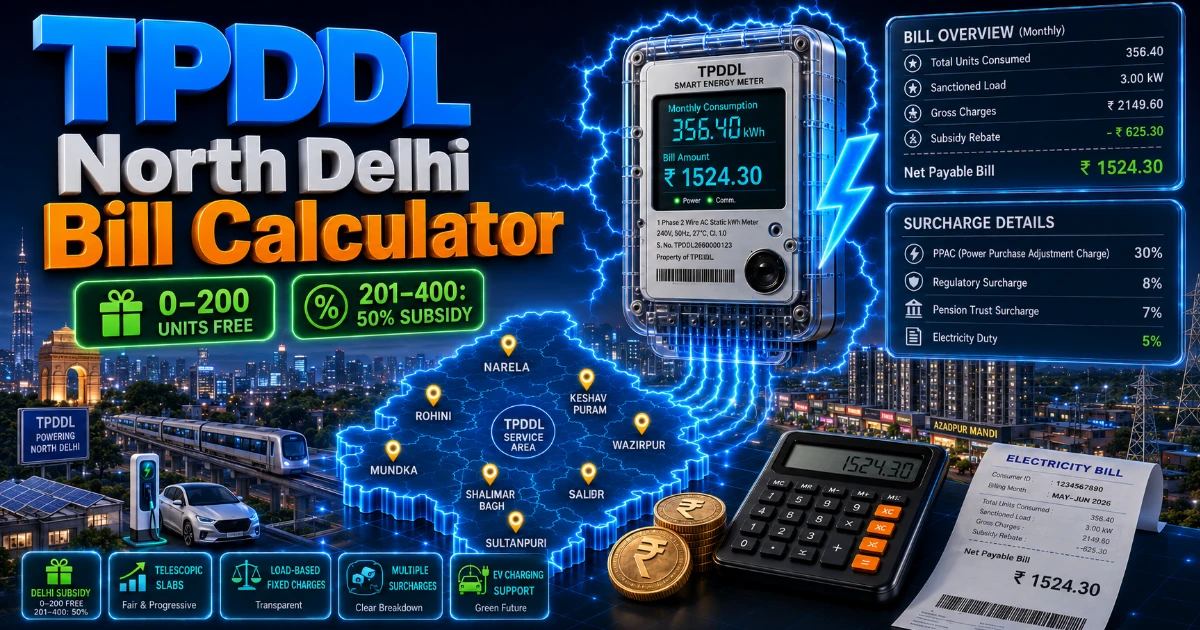
Calculating a Delhi electricity bill manually can be difficult because domestic telescopic slabs, sanctioned-load-based fixed charges, government subsidy, Power Purchase Adjustment Cost, Regulatory Surcharge, Pension Trust Surcharge, and Electricity Duty must be calculated separately.
- What Is the TPDDL Electricity Bill Calculator?
- How the Delhi Government Electricity Subsidy Works
- Load-Based Domestic Fixed Charges
- Supported TPDDL Connection Categories
- How to Use the TPDDL Electricity Bill Calculator
- Key Features of the TPDDL Electricity Bill Calculator
- How the Estimated TPDDL Bill Is Prepared
- Why Is Our TPDDL Electricity Bill Calculator Different From Other Tools?
- TPDDL Domestic Telescopic Tariff Slabs
- How the Delhi Domestic Subsidy Is Calculated
- TPDDL Surcharges and Electricity Duty
- Non-Domestic Commercial LT Tariff
- EV Charging Station LT Tariff
- How the Estimated TPDDL Bill Is Calculated
- Electricity-Saving Tips for TPDDL Consumers
- Frequently Asked Questions
- Meta Information
- Featured Image Prompt
The TPDDL Electricity Bill Calculator is a smart online utility designed for electricity consumers served by Tata Power Delhi Distribution Limited in North and North-West Delhi. It helps domestic households, commercial establishments, and EV charging operators estimate their monthly electricity expenses before receiving the official bill.
Using the supplied Delhi Electricity Regulatory Commission FY 2026–27 tariff information, the calculator supports Domestic Supply telescopic slabs, the configured Delhi Government electricity subsidy, Non-Domestic Commercial LT rates, EV charging tariffs, load-based fixed charges, PPAC, Regulatory Surcharge, Pension Trust Surcharge, and 5% Electricity Duty.
Electricity usage can differ considerably among consumers. A small household may remain within the 200-unit subsidy limit, while a larger family using air conditioners, water pumps, refrigerators, heaters, and other appliances may enter a higher tariff bracket. Similarly, shops, offices, restaurants, clinics, and other commercial premises generally have higher energy rates and fixed demand charges.
The calculator simplifies the complete process by showing slab-wise energy charges, fixed monthly charges, PPAC, regulatory and pension surcharges, government subsidy rebate, Electricity Duty, and the estimated net payable amount in a transparent itemized report.
What Is the TPDDL Electricity Bill Calculator?
The TPDDL Electricity Bill Calculator is an online electricity bill estimation tool for Tata Power Delhi Distribution Limited consumers. It calculates an expected monthly bill using total electricity consumption, connection category, sanctioned load, and domestic subsidy status.
Unlike a basic calculator that multiplies all consumed units by one general electricity rate, this tool follows the supplied tariff logic for each supported TPDDL consumer category.
Domestic electricity consumption is calculated through telescopic tariff slabs. Under telescopic calculation, different portions of the monthly consumption are charged at different energy rates.
The supplied Domestic Supply energy slabs are:
- 0–200 units: ₹3.00 per unit before subsidy adjustment
- 201–400 units: ₹4.50 per unit for the applicable slab
- 401–800 units: ₹6.50 per unit
- 801–1200 units: ₹7.00 per unit
- Above 1200 units: ₹8.00 per unit
For example, when a domestic consumer uses 500 units, the calculator does not multiply all 500 units by ₹6.50. It divides the electricity consumption across the applicable tariff slabs, calculates the load-based fixed charge, adds configured surcharges, checks subsidy eligibility, and calculates Electricity Duty.
This slab-wise method provides a more meaningful estimate than applying the highest tariff rate to the complete monthly consumption.
How the Delhi Government Electricity Subsidy Works
The calculator supports the supplied Delhi Government opt-in domestic electricity subsidy rules. The subsidy option should remain enabled only when the consumer is registered and eligible under the applicable scheme.
Under the supplied calculator configuration:
- Consumption up to 200 units: Eligible domestic consumers receive the configured 100% subsidy benefit.
- Consumption from 201 to 400 units: Eligible consumers receive a 50% subsidy rebate, subject to a maximum benefit of ₹800.
- Consumption above 400 units: Standard domestic billing applies without the configured subsidy.
For consumption within 200 units, the supplied scheme describes a zero net bill benefit for eligible consumers. The calculator should show the gross energy charge, fixed charge, applicable surcharges, subsidy adjustment, and resulting payable amount according to its configured subsidy formula.
For consumption between 201 and 400 units, the calculator first calculates the gross bill components. It then applies a 50% subsidy rebate, limited to a maximum of ₹800.
For example, if the eligible subsidy amount calculated at 50% is ₹650, the complete ₹650 rebate can be applied. If the calculated subsidy is ₹1,050, the benefit should be limited to ₹800 under the supplied rule.
Once monthly consumption exceeds 400 units, the subsidy is not applied, and normal tariff rates, fixed charges, surcharges, and duty determine the estimated bill.
Load-Based Domestic Fixed Charges
The domestic fixed monthly charge depends on the sanctioned load of the electricity connection rather than the number of consumed units.
- Load up to 2 kW: ₹20 per month
- Load from 2.1 to 5 kW: ₹50 per month
- Load from 5.1 to 15 kW: ₹100 per month
- Load from 15.1 to 25 kW: ₹200 per month
- Load above 25 kW: ₹250 per month
Entering the correct sanctioned load is important because an incorrect load bracket can change the estimated fixed charge and the surcharge amounts calculated on applicable billing components.
Supported TPDDL Connection Categories
The calculator supports the following connection categories using the supplied tariff information:
- Domestic Supply with Delhi Government subsidy
- Domestic Supply without subsidy
- Non-Domestic Commercial LT up to 10 kW
- EV Charging Station LT
Each category follows different energy rates, fixed-charge rules, and subsidy conditions. Consumers should select the tariff category printed on their latest TPDDL electricity bill rather than choosing a category only according to the type of property.
Commercial consumers do not receive the domestic electricity subsidy. EV charging connections also follow their own dedicated energy tariff and do not receive the Domestic Supply free-electricity benefit.
How to Use the TPDDL Electricity Bill Calculator
Calculate Your TPDDL Bill in Five Simple Steps
Keep your latest TPDDL electricity bill or monthly meter reading ready before beginning the calculation.
Step 1: Select the Connection Category
Choose Domestic Supply, Non-Domestic Commercial LT, or EV Charging according to the tariff category printed on your electricity bill.
Step 2: Enter Monthly Electricity Units
Enter the total electricity consumed during the monthly billing cycle. You can find the billed units on the latest bill or calculate them by subtracting the previous meter reading from the current reading.
Step 3: Enter the Sanctioned Load
Enter the connected load in kW. The calculator uses this value to select the applicable domestic fixed-charge bracket or calculate the commercial fixed demand charge.
Step 4: Select the Delhi Subsidy Status
Eligible Domestic Supply consumers can keep the subsidy option enabled. The calculator automatically hides or disables this option when Commercial LT or EV Charging is selected.
Step 5: Calculate the Bill
Click the Calculate Bill button to view gross energy charges, fixed charges, PPAC, Regulatory Surcharge, Pension Trust Surcharge, subsidy rebate, Electricity Duty, and the estimated net payable amount.
Key Features of the TPDDL Electricity Bill Calculator
DERC FY 2026–27 Tariff Structure
The calculator uses the supplied Delhi tariff information for domestic, commercial, and EV charging connections.
Domestic Subsidy Validation
The tool checks whether consumption is within 200 units, between 201 and 400 units, or above the subsidy limit.
Telescopic Domestic Slabs
Domestic consumption is distributed across the 0–200, 201–400, 401–800, 801–1200, and above 1200-unit slabs.
Load-Based Fixed Charges
Domestic fixed charges are selected automatically according to the sanctioned-load bracket entered by the consumer.
PPAC Surcharge Breakdown
The configured 30% Power Purchase Adjustment Cost is calculated and displayed as a separate bill component.
Regulatory and Pension Surcharges
The tool separately displays the configured 8% Regulatory Surcharge and 7% Pension Trust Surcharge.
Commercial LT Calculation
Commercial consumers can estimate energy charges at ₹8.50 per unit and fixed charges at ₹250 per kW per month.
EV Charging Support
EV Charging Station LT consumption is calculated at the supplied rate of ₹4.50 per unit with no fixed monthly charge.
5% Electricity Duty
The configured Electricity Duty is calculated and displayed separately according to the taxable components used by the tool.
Downloadable Itemized Report
The report can show tariff slabs, sanctioned load, fixed charges, surcharges, subsidy rebate, duty, and estimated total.
How the Estimated TPDDL Bill Is Prepared
The calculator first identifies the selected consumer category and monthly electricity consumption. Domestic units are distributed across the applicable telescopic slabs, after which the correct sanctioned-load-based fixed charge is selected.
The calculator then computes the configured PPAC, Regulatory Surcharge, and Pension Trust Surcharge. For eligible domestic consumers, it applies the applicable subsidy according to the 0–200, 201–400, or above-400-unit bracket.
Commercial LT consumers are calculated using the supplied flat energy rate and per-kW fixed demand charge. EV charging consumption is calculated using the configured EV tariff without a monthly fixed charge.
Finally, the calculator applies the configured 5% Electricity Duty and displays every bill component separately.
The final result remains an estimate. An official TPDDL bill may include previous arrears, delayed payment surcharge, meter charges, security-deposit adjustments, subsidy corrections, penalties, rounding differences, or revised surcharge values.
Why Is Our TPDDL Electricity Bill Calculator Different From Other Tools?
A TPDDL electricity bill cannot always be estimated by multiplying total monthly consumption by one electricity rate. Domestic consumers follow telescopic tariff slabs, sanctioned-load-based fixed charges, multiple surcharges, Electricity Duty, and conditional Delhi Government subsidy rules.
The TPDDL Electricity Bill Calculator processes these components separately. It distributes domestic consumption across the applicable slabs, selects the correct fixed-charge bracket, calculates PPAC, Regulatory Surcharge and Pension Trust Surcharge, applies the configured subsidy, and displays the estimated Electricity Duty and net payable amount.
| Feature | TPDDL Calculator | Basic Calculator |
|---|---|---|
| Domestic Slab Calculation | Calculates every applicable slab separately | May multiply all units by one rate |
| Delhi Subsidy | Checks the 200-unit and 400-unit limits | May apply one general discount |
| Fixed Charge | Selects the charge according to sanctioned load | May ignore the connected load |
| Surcharge Breakdown | Displays PPAC, regulatory, pension and duty separately | Usually displays only a rough total |
TPDDL Domestic Telescopic Tariff Slabs
Domestic electricity consumption is divided across five supplied tariff slabs. Only the units falling within a particular bracket are calculated at that bracket’s rate.
| Monthly Consumption | Energy Rate | Subsidy Treatment |
|---|---|---|
| 0–200 units | ₹3.00/unit | Configured 100% subsidy for eligible consumers |
| 201–400 units | ₹4.50/unit | 50% rebate, limited to ₹800 |
| 401–800 units | ₹6.50/unit | No subsidy |
| 801–1200 units | ₹7.00/unit | No subsidy |
| Above 1200 units | ₹8.00/unit | No subsidy |
How the Delhi Domestic Subsidy Is Calculated
The subsidy option should be enabled only for an eligible domestic consumer registered under the applicable opt-in scheme.
- Up to 200 units: The supplied calculator configuration applies a 100% subsidy and may reduce the eligible net bill to ₹0.
- 201–400 units: A 50% rebate is applied, subject to a maximum benefit of ₹800.
- Above 400 units: Standard billing applies without subsidy.
- Commercial and EV categories: Domestic subsidy is not applicable.
The detailed report should show the gross bill before subsidy, calculated rebate, subsidy cap where applicable, and estimated amount remaining after the adjustment.
Example: Eligible Domestic Consumer Using 180 Units
Suppose an eligible domestic consumer uses 180 units with a sanctioned load of 2 kW.
- Energy charge: 180 × ₹3.00 = ₹540
- Fixed monthly charge: ₹20
- Base amount: ₹560
- Configured surcharges and duty: Calculated separately
- Domestic subsidy: Applied according to the supplied 0–200-unit zero-bill configuration
- Estimated net bill: ₹0 when all scheme conditions are satisfied
The calculator can still display the gross bill components before applying the subsidy so users can understand the estimated value of the government benefit.
Example: Eligible Domestic Consumer Using 250 Units
For 250 units, the gross slab-wise energy charge is:
- First 200 units: 200 × ₹3.00 = ₹600
- Remaining 50 units: 50 × ₹4.50 = ₹225
- Total energy charge: ₹825
- Fixed charge for 2 kW: ₹20
- Base amount: ₹845
For illustration, when PPAC, Regulatory Surcharge and Pension Trust Surcharge are each applied to the base amount:
- PPAC at 30%: ₹253.50
- Regulatory Surcharge at 8%: ₹67.60
- Pension Trust Surcharge at 7%: ₹59.15
- Subtotal before duty: ₹1,225.25
- Illustrative 5% duty: ₹61.26
- Gross estimated bill: ₹1,286.51
- Illustrative 50% subsidy: ₹643.26
- Estimated payable amount: ₹643.25
The calculated rebate remains below the ₹800 maximum. The official surcharge, subsidy and duty bases should be checked against the actual TPDDL bill.
Example: Domestic Consumer Using 500 Units
Consumption above 400 units does not receive the configured subsidy.
- First 200 units: 200 × ₹3.00 = ₹600
- Next 200 units: 200 × ₹4.50 = ₹900
- Remaining 100 units: 100 × ₹6.50 = ₹650
- Total energy charge: ₹2,150
- Fixed charge for a 3 kW load: ₹50
- Base amount: ₹2,200
- Subsidy rebate: ₹0
Configured surcharges and Electricity Duty are added separately to determine the estimated final amount.
TPDDL Surcharges and Electricity Duty
The supplied calculator data includes four additional billing components:
- Power Purchase Adjustment Cost: 30%
- Regulatory Surcharge: 8%
- Pension Trust Surcharge: 7%
- Electricity Duty: 5%
The three supplied surcharges total 45% when they are calculated independently on the same base amount. Their actual billing base, sequence and current applicability should be confirmed from the official TPDDL bill because percentage-based charges may be revised or applied to selected components.
Non-Domestic Commercial LT Tariff
The Non-Domestic Commercial LT category may apply to eligible shops, offices, clinics, restaurants, hotels and other commercial premises with load up to 10 kW.
- Energy charge: ₹8.50 per unit
- Fixed demand charge: ₹250 per kW per month
- Domestic subsidy: Not applicable
Example: Commercial Consumer Using 300 Units
- Energy charge: 300 × ₹8.50 = ₹2,550
- Fixed charge for 5 kW: 5 × ₹250 = ₹1,250
- Base amount: ₹3,800
- PPAC at 30%: ₹1,140
- Regulatory Surcharge at 8%: ₹304
- Pension Trust Surcharge at 7%: ₹266
- Subtotal before duty: ₹5,510
- Illustrative 5% duty: ₹275.50
- Illustrative total: ₹5,785.50
EV Charging Station LT Tariff
- Energy charge: ₹4.50 per unit
- Fixed monthly charge: ₹0
- Domestic subsidy: Not applicable
An EV charging connection using 1,000 units receives a basic energy charge of ₹4,500. Applicable surcharges and Electricity Duty are calculated separately according to the configured billing rules.
How the Estimated TPDDL Bill Is Calculated
- Select the correct connection category.
- Enter total monthly electricity consumption.
- Enter sanctioned load in kW.
- Enable the Delhi subsidy only for an eligible domestic connection.
- Calculate domestic consumption through telescopic slabs.
- Add the applicable fixed monthly charge.
- Calculate PPAC, Regulatory and Pension Trust surcharges.
- Apply the eligible subsidy and ₹800 cap.
- Calculate the configured Electricity Duty.
- Display every component and the estimated net payable amount.
Electricity-Saving Tips for TPDDL Consumers
- Monitor consumption carefully near the 200-unit and 400-unit subsidy limits.
- Use LED lighting and energy-efficient fans.
- Set air conditioners near 24–26°C and clean filters regularly.
- Switch off unused appliances and standby devices.
- Maintain refrigerators, water pumps and commercial equipment.
- Check the sanctioned load printed on the latest TPDDL bill.
- Compare current consumption with previous monthly bills.
- Enable the subsidy option only when officially registered and eligible.
The official TPDDL bill may also include arrears, delayed payment surcharge, meter charges, security-deposit adjustments, penalties, subsidy corrections, rounding differences, or revised surcharge percentages.
Frequently Asked Questions
How accurate is the TPDDL Electricity Bill Calculator?
The calculator uses the supplied DERC FY 2026–27 tariff information to estimate Domestic Supply, Non-Domestic Commercial LT, and EV Charging bills. It includes telescopic energy slabs, sanctioned-load-based fixed charges, subsidy adjustments, PPAC, Regulatory Surcharge, Pension Trust Surcharge, and 5% Electricity Duty. The official bill may differ because of revised surcharge rates, arrears, penalties, or account-specific adjustments.
Which areas can use the TPDDL Electricity Bill Calculator?
The calculator is intended for eligible consumers served by Tata Power Delhi Distribution Limited in North and North-West Delhi. Users should confirm that TPDDL is the electricity distribution company printed on their latest bill.
What is the Delhi Government electricity subsidy?
Under the supplied calculator configuration, eligible opted-in Domestic Supply consumers using up to 200 units may receive a 100% subsidy benefit. Consumption from 201 to 400 units may receive a 50% rebate, limited to a maximum of ₹800.
Does every domestic consumer automatically receive the subsidy?
No. The subsidy option should only be enabled when the consumer is registered and eligible under the applicable opt-in scheme. Selecting the subsidy checkbox does not independently confirm official eligibility.
Is the complete TPDDL bill zero below 200 units?
The supplied configuration describes a zero-net-bill benefit for eligible domestic consumption up to 200 units. The calculator may still display gross energy, fixed-charge, surcharge, and duty components before applying the subsidy. Arrears or account-specific charges can affect the official bill.
What subsidy applies between 201 and 400 units?
Eligible domestic consumers in this consumption range receive a configured 50% rebate. However, the subsidy cannot exceed ₹800. If 50% of the eligible amount is above ₹800, the calculator limits the rebate to ₹800.
What happens when consumption exceeds 400 units?
When monthly domestic consumption exceeds 400 units, the supplied subsidy does not apply. The calculator uses normal telescopic tariff rates and adds the applicable fixed charge, surcharges, and Electricity Duty.
How does the domestic telescopic calculation work?
Monthly consumption is divided across separate tariff slabs. Only the units falling within a specific slab are charged at that slab’s rate instead of multiplying the complete consumption by the highest applicable rate.
What are the TPDDL domestic electricity rates?
Under the supplied data, the first 200 units are charged at ₹3.00 per unit, units from 201 to 400 at ₹4.50, units from 401 to 800 at ₹6.50, units from 801 to 1200 at ₹7.00, and units above 1200 at ₹8.00 before subsidy adjustments.
How are 250 domestic units calculated?
For 250 units, the first 200 units are calculated at ₹3.00 and the remaining 50 units at ₹4.50 per unit. The gross energy charge is ₹825 before fixed charges, surcharges, duty, and the eligible 50% subsidy adjustment.
How are 500 domestic electricity units calculated?
For 500 units, the first 200 units cost ₹600, the next 200 cost ₹900, and the remaining 100 cost ₹650. The gross energy charge is ₹2,150. Since consumption exceeds 400 units, no domestic subsidy applies.
How is the domestic fixed monthly charge selected?
The fixed charge depends on sanctioned load. Under the supplied data, it is ₹20 up to 2 kW, ₹50 from 2.1 to 5 kW, ₹100 from 5.1 to 15 kW, ₹200 from 15.1 to 25 kW, and ₹250 above 25 kW.
Where can I find my sanctioned load?
The sanctioned load is generally printed on the latest TPDDL electricity bill or connection document. Consumers should use the official kW value instead of estimating it from the number of installed appliances.
What is PPAC in a TPDDL electricity bill?
PPAC means Power Purchase Adjustment Cost. The supplied calculator configuration uses a 30% PPAC. It is displayed separately so users can understand how power-purchase-related adjustments affect the estimated bill.
What is the Regulatory Surcharge?
The supplied Regulatory Surcharge is 8%. The calculator applies it to the configured billing base and displays it separately from the energy charge, fixed charge, PPAC, subsidy, and Electricity Duty.
What is the Pension Trust Surcharge?
The supplied Pension Trust Surcharge is 7%. It is included as a separate estimate because Delhi electricity bills may contain multiple percentage-based surcharge components.
Do PPAC, Regulatory, and Pension surcharges total 45%?
The supplied percentages total 45% when added directly. However, the actual billing base, calculation sequence, and current applicability may differ. The calculator should follow its configured surcharge logic, and users should compare the result with the official TPDDL bill.
How is 5% Electricity Duty calculated?
The calculator applies the configured 5% Electricity Duty to the taxable billing components used by the tool. The estimated duty is displayed separately. The exact taxable base should be confirmed from the official bill.
Can commercial consumers claim the Delhi domestic subsidy?
No. The configured subsidy applies only to eligible Domestic Supply consumers. The calculator automatically hides or disables the subsidy option when Non-Domestic Commercial LT or EV Charging is selected.
How is a Commercial LT bill calculated?
Commercial LT consumption is calculated at the supplied rate of ₹8.50 per unit. A fixed demand charge of ₹250 per kW per month is added according to sanctioned load, followed by the configured surcharges and Electricity Duty.
Does the calculator support EV charging stations?
Yes. EV Charging Station LT consumption is calculated at the supplied rate of ₹4.50 per unit with no monthly fixed charge. The domestic electricity subsidy is not applied to this category.
Why can the estimate differ from the official TPDDL bill?
The official bill may include revised PPAC, updated surcharge percentages, arrears, delayed payment surcharge, meter charges, security-deposit adjustments, subsidy corrections, penalties, and rounding differences not included in the estimate.
Can I download or print the detailed TPDDL bill report?
Yes. The detailed report can show category, monthly consumption, tariff slabs, sanctioned load, fixed charges, PPAC, Regulatory Surcharge, Pension Trust Surcharge, subsidy rebate, Electricity Duty, and estimated payable amount.
Meta Information
Meta Title: TPDDL Electricity Bill Calculator | Delhi Subsidy 2026
Meta Description: Calculate your TPDDL electricity bill using supplied DERC FY 2026-27 rates. Check Delhi subsidy, domestic slabs, PPAC, surcharges and duty.
Focus Keyword: TPDDL Electricity Bill Calculator
Post Slug: tpddl-electricity-bill-calculator
Meta URL: /delhi/tpddl-electricity-bill-calculator
Featured Image Title: TPDDL Electricity Bill Calculator With Delhi Subsidy
Featured Image Alt Tag: TPDDL Electricity Bill Calculator showing Delhi electricity subsidy, smart meter, tariff slabs, PPAC and bill summary
Featured Image Caption: Estimate TPDDL domestic, commercial and EV electricity charges with Delhi subsidy and surcharge calculations.
Featured Image Prompt
Create a premium glossy 3D electricity bill calculator poster in 1200×630 landscape format. On the left, place large sharp 3D text in three lines: “TPDDL” in bright electric blue, “North Delhi” in glossy white or silver, and “Bill Calculator” in vivid orange. Add two glowing green badges reading “0–200 UNITS FREE” and “201–400: 50% SUBSIDY.” In the center-right, show a realistic modern smart electricity meter with a glowing digital display showing monthly units and a rupee bill amount, surrounded by intense cyan lightning and flowing energy lines. On the far right, add two floating glass panels: a Bill Overview panel showing total units, sanctioned load, gross charges, subsidy rebate and net bill; and a Surcharge Details panel showing PPAC 30%, Regulatory Surcharge 8%, Pension Trust Surcharge 7%, and Electricity Duty 5%. At the bottom right, place a black digital calculator with orange buttons, metallic rupee coins and a printed electricity bill receipt. At the bottom center, create a raised glowing 3D map of North and North-West Delhi with highlighted service zones. Add subtle regional elements including the Delhi skyline, metro structures, residential colonies, commercial markets, EV charging stations, solar rooftops, electricity substations, transmission towers and futuristic smart-grid lines. Include glowing feature tiles for Delhi Subsidy, Telescopic Slabs, Load-Based Fixed Charges, Multiple Surcharges and EV Charging. Use a deep navy-blue background, intense cyan glow, glossy white highlights, green subsidy accents and rich orange-gold details. Keep the title highly readable, maintain a clean balanced composition, and include no people, watermark or unrelated logos.