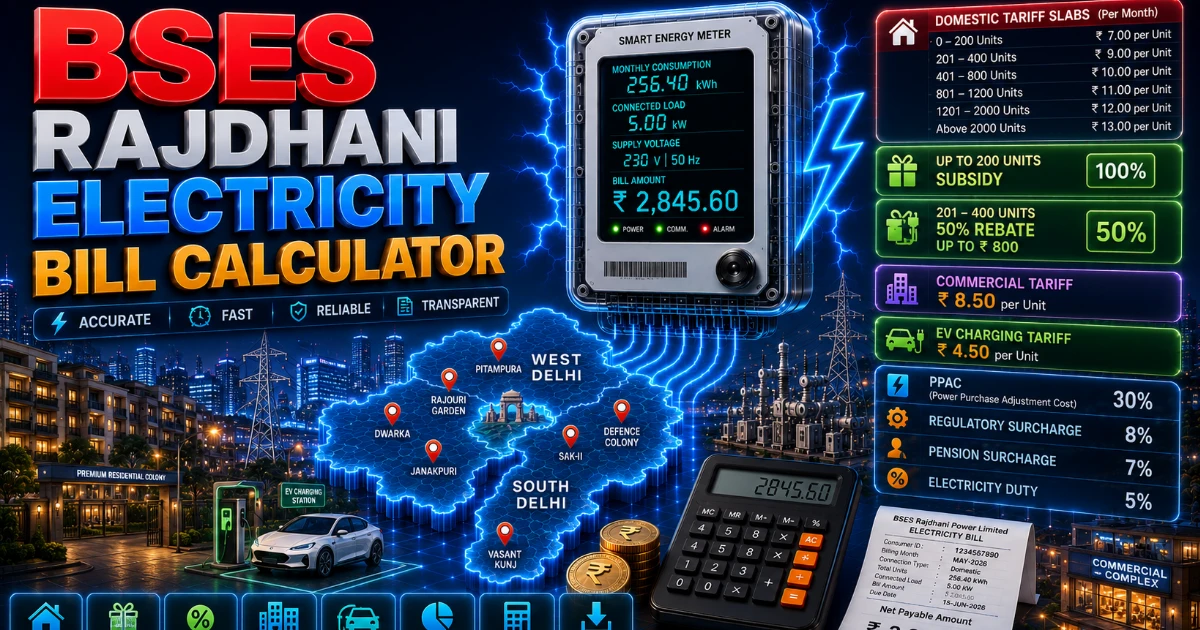
The BSES Rajdhani Electricity Bill Calculator is an online utility designed to help electricity consumers estimate their monthly power bill. It is intended for eligible BSES Rajdhani Power Limited consumers across South Delhi, West Delhi, and other covered BRPL service areas.
- What Is the BSES Rajdhani Electricity Bill Calculator?
- BSES Rajdhani Domestic Tariff Slabs
- Domestic Fixed Monthly Charges
- How the Delhi Domestic Subsidy Is Calculated
- Mandatory Surcharges and Electricity Duty
- Non-Domestic Commercial LT Tariff
- EV Charging Station Tariff
- How to Use the BSES Rajdhani Bill Calculator
- Frequently Asked Questions
Using the supplied DERC FY 2026–27 tariff information, the calculator supports Domestic Supply, Non-Domestic Commercial LT, and EV Charging Station connections. It calculates telescopic energy charges, sanctioned-load-based fixed charges, PPAC, Regulatory Surcharge, Pension Trust Surcharge, Electricity Duty, government subsidy deductions, and the estimated net payable amount.
Delhi electricity billing can be difficult to calculate manually because several percentage-based surcharges may apply in addition to the basic energy and fixed charges. Domestic consumers may also qualify for the configured Delhi Government electricity subsidy when they are officially registered under the opt-in scheme.
What Is the BSES Rajdhani Electricity Bill Calculator?
The calculator prepares an estimated monthly electricity bill using:
- Selected electricity connection category
- Total monthly consumption in kWh
- Sanctioned or connected load in kW
- Domestic subsidy registration status
- Applicable telescopic or flat energy tariff
- Load-based fixed monthly charge
- PPAC, Regulatory, and Pension Trust surcharges
- Configured 5% Electricity Duty
The detailed report can show the gross energy charge, fixed charge, individual surcharges, subsidy deduction, Electricity Duty, and estimated payable amount separately. It may also be printed or downloaded for future reference.
BSES Rajdhani Domestic Tariff Slabs
| Monthly Consumption | Energy Rate | Subsidy Treatment |
|---|---|---|
| 0–200 units | ₹3.00 per unit | Configured 100% benefit for eligible registered users |
| 201–400 units | ₹4.50 per unit | 50% subsidy, limited to ₹800 |
| 401–800 units | ₹6.50 per unit | No subsidy |
| 801–1200 units | ₹7.00 per unit | No subsidy |
| Above 1200 units | ₹8.00 per unit | No subsidy |
The energy charge is calculated telescopically. Only the electricity units falling within a particular slab are charged at that slab’s rate.
Domestic Fixed Monthly Charges
- Load up to 2 kW: ₹20 per month
- Load from 2.1 to 5 kW: ₹50 per month
- Load from 5.1 to 15 kW: ₹100 per month
- Load from 15.1 to 25 kW: ₹200 per month
- Load above 25 kW: ₹250 per month
The calculator automatically selects the applicable fixed-charge bracket from the sanctioned load entered by the consumer.
How the Delhi Domestic Subsidy Is Calculated
Under the supplied calculator configuration:
- Up to 200 units: An eligible registered consumer may receive a 100% subsidy and an estimated net bill of ₹0.
- 201–400 units: An eligible registered consumer may receive a 50% rebate, subject to a maximum subsidy of ₹800.
- Above 400 units: No subsidy is applied, and the complete calculated bill becomes payable.
The subsidy should only be enabled by a consumer officially registered under the applicable opt-in scheme. Selecting the subsidy option does not independently confirm eligibility.
The calculator should display the gross bill and subsidy deduction separately because the official scheme may define which components are included in the subsidy base.
Example: Domestic Consumer Using 250 Units
Suppose a registered Domestic consumer uses 250 units with a sanctioned load of 2 kW.
- First 200 units: 200 × ₹3.00 = ₹600
- Remaining 50 units: 50 × ₹4.50 = ₹225
- Total energy charge: ₹825
- Fixed monthly charge: ₹20
- Configured subsidy: 50% of the eligible subsidy base, limited to ₹800
The PPAC, Regulatory Surcharge, Pension Trust Surcharge, Electricity Duty, and subsidy should be displayed separately. Their exact application base must follow the billing configuration used by the calculator and should be compared with the actual BRPL bill.
Mandatory Surcharges and Electricity Duty
- Power Purchase Adjustment Cost: 30%
- Regulatory Surcharge: 8%
- Pension Trust Surcharge: 7%
- Electricity Duty: 5%
These charges can significantly increase the gross bill. The calculator should not combine them into one hidden amount. Each surcharge should be displayed separately with its configured calculation base.
The official surcharge percentages or taxable bases may be revised. Consumers should therefore compare the estimate with their latest BSES Rajdhani electricity bill.
Non-Domestic Commercial LT Tariff
- Energy charge: ₹8.50 per unit
- Fixed demand charge: ₹250 per kW per month
- Domestic subsidy: Not applicable
Example: Commercial Consumer Using 400 Units
For a Commercial connection using 400 units with a sanctioned load of 5 kW:
- Energy charge: 400 × ₹8.50 = ₹3,400
- Fixed demand charge: 5 × ₹250 = ₹1,250
- Basic subtotal: ₹4,650
PPAC, Regulatory Surcharge, Pension Trust Surcharge, and Electricity Duty are then added according to the configured commercial billing rules.
EV Charging Station Tariff
- Energy charge: ₹4.50 per unit
- Fixed charge: ₹0
- Domestic subsidy: Not applicable
An EV charging station using 500 units receives a basic energy charge of ₹2,250. Applicable surcharges and Electricity Duty are calculated separately.
How to Use the BSES Rajdhani Bill Calculator
Step 1: Select Domestic, Commercial LT, or EV Charging.
Step 2: Enter the complete monthly electricity consumption.
Step 3: Enter the sanctioned load in kW.
Step 4: Domestic consumers should enable the subsidy option only when officially registered.
Step 5: Click Calculate Bill to view energy charges, fixed charges, surcharges, subsidy, duty, and the estimated payable amount.
Frequently Asked Questions
Is electricity free up to 200 units?
Under the supplied configuration, eligible registered Domestic consumers using no more than 200 units may receive a 100% subsidy.
What subsidy applies from 201 to 400 units?
The configured benefit is 50% of the eligible bill amount, limited to a maximum rebate of ₹800.
Is subsidy available above 400 units?
No. The supplied rules apply normal billing when consumption exceeds 400 units.
What is PPAC?
PPAC means Power Purchase Adjustment Cost. The supplied calculator configuration uses a 30% rate.
Does the calculator support South and West Delhi?
Yes. It is intended for eligible BRPL consumers across covered South and West Delhi service areas.
Why can the official bill differ?
The official bill may include revised surcharge rates, arrears, delayed payment charges, meter adjustments, penalties, subsidy corrections, or rounding differences.