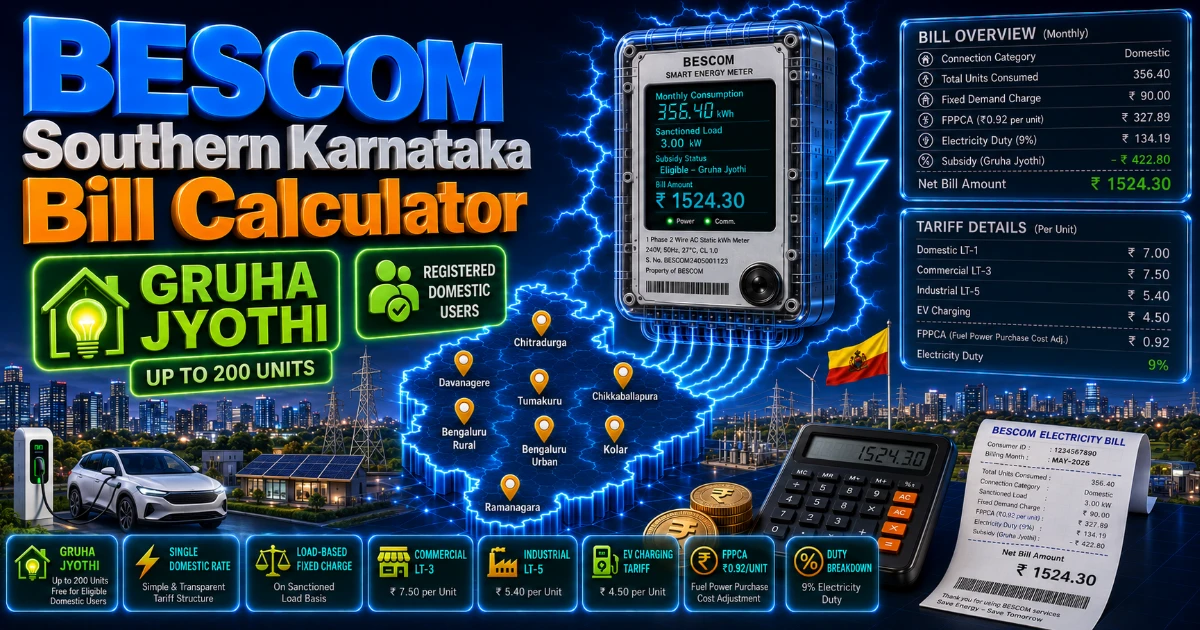
Calculating a Bengaluru electricity bill manually can be difficult because the final payable amount includes more than electricity consumption charges. The calculation may also involve sanctioned-load-based fixed charges, Fuel and Power Purchase Cost Adjustment, Electricity Duty, and the Karnataka Government’s Gruha Jyothi subsidy.
- What Is the BESCOM Electricity Bill Calculator?
- BESCOM LT-1 Domestic Electricity Tariff
- How the Gruha Jyothi Scheme Works
- Sanctioned-Load-Based Domestic Fixed Charge
- FPPCA Fuel Surcharge
- Electricity Duty Calculation
- Supported BESCOM Connection Categories
- Commercial LT-3 Tariff Overview
- Industrial LT-5 Tariff Overview
- EV Charging Station Tariff
- How to Use the BESCOM Electricity Bill Calculator
- Key Features of the BESCOM Electricity Bill Calculator
- How the Estimated BESCOM Bill Is Prepared
- Why Is Our BESCOM Electricity Bill Calculator Different From Other Tools?
- BESCOM LT-1 Domestic Tariff and Gruha Jyothi Rules
- How the Gruha Jyothi Subsidy Is Calculated
- Sanctioned-Load-Based Domestic Fixed Charges
- LT-3 Non-Domestic Commercial Tariff
- LT-5 Industrial Motive Power Tariff
- LT-6(c) EV Charging Station Tariff
- How the Estimated BESCOM Bill Is Calculated
- Electricity-Saving Tips for BESCOM Consumers
- Frequently Asked Questions
The BESCOM Electricity Bill Calculator is an online utility designed for consumers served by Bangalore Electricity Supply Company Limited. It helps domestic households, commercial establishments, industrial consumers, and EV charging operators estimate their monthly electricity expenses before receiving the official bill.
Using the supplied Karnataka Electricity Regulatory Commission FY 2026–27 tariff information, the calculator supports LT-1 Domestic connections, the configured Gruha Jyothi Scheme benefit, LT-3 Commercial Power and Lighting, LT-5 Industrial Motive Power, LT-6(c) EV Charging Stations, fixed demand charges, FPPCA, and 9% Electricity Duty.
The tool is intended for eligible BESCOM consumers across Bengaluru Urban, Bengaluru Rural, Kolar, Tumakuru, Ramanagara, Chikkaballapura, Chitradurga, Davanagere, and other covered Southern Karnataka service areas.
Electricity usage can vary significantly between consumers. A registered household using up to 200 units may qualify for the configured Gruha Jyothi benefit, while a household crossing the prescribed limit may become liable for the complete calculated bill. Shops, offices, restaurants, technology businesses, workshops, industries, and public EV charging stations follow separate energy and demand-charge structures.
The calculator simplifies the complete process by displaying energy charges, sanctioned-load-based fixed charges, FPPCA, Electricity Duty, Gruha Jyothi subsidy adjustment, and the estimated net payable amount in a transparent itemized report.
What Is the BESCOM Electricity Bill Calculator?
The BESCOM Electricity Bill Calculator is an online electricity bill estimation tool for consumers served by Bangalore Electricity Supply Company Limited.
It calculates an expected monthly bill using:
- Total electricity consumption in kWh
- Selected connection category
- Sanctioned load in kW or HP
- Gruha Jyothi beneficiary status
- Applicable fixed demand charge
- Fuel surcharge or FPPCA
- Configured Electricity Duty
Unlike a traditional domestic calculator that distributes electricity consumption across several tariff slabs, the supplied BESCOM LT-1 structure uses a simplified single energy rate of ₹7.00 per unit.
The basic domestic energy charge is therefore calculated by multiplying total monthly consumption by ₹7.00. The fixed demand charge, FPPCA, Electricity Duty, and eligible subsidy adjustment are then processed separately.
BESCOM LT-1 Domestic Electricity Tariff
Under the supplied FY 2026–27 tariff configuration, LT-1 Domestic consumers use the following rates:
- Energy charge: ₹7.00 per unit
- Fixed demand charge: ₹115 per kW per month
- FPPCA: ₹0.92 per billed unit
- Electricity Duty: 9% according to the taxable components configured in the tool
For example, when a domestic consumer uses 180 units, the gross energy charge before subsidy is:
180 × ₹7.00 = ₹1,260
If the sanctioned load is 2 kW, the fixed demand charge is:
2 × ₹115 = ₹230
The applicable FPPCA and Electricity Duty are calculated separately before the Gruha Jyothi adjustment is displayed.
How the Gruha Jyothi Scheme Works
The calculator supports the supplied Karnataka Government Gruha Jyothi Scheme configuration for eligible registered Domestic LT-1 beneficiaries.
Under the provided calculation rule:
- Monthly consumption up to 200 units: An eligible registered beneficiary may receive a 100% subsidy and an estimated net bill of ₹0.
- Monthly consumption above 200 units: The subsidy does not apply, and the complete calculated bill becomes payable.
- Commercial, Industrial, and EV categories: Gruha Jyothi does not apply.
The calculator should first prepare the gross domestic bill and then show the configured subsidy deduction. This allows consumers to understand the estimated value of energy charges, fixed charges, FPPCA, duty, and the government benefit.
The subsidy option should only be enabled by an officially registered and eligible consumer. Selecting the checkbox in the calculator does not independently confirm scheme eligibility.
Example: Eligible Domestic Consumer Using 180 Units
Suppose an eligible Gruha Jyothi beneficiary uses 180 units with a sanctioned load of 2 kW.
- Energy charge: 180 × ₹7.00 = ₹1,260
- Fixed demand charge: 2 × ₹115 = ₹230
- FPPCA: 180 × ₹0.92 = ₹165.60
- Electricity Duty: Calculated according to the configured taxable base
- Gross estimated bill: Displayed before subsidy
- Gruha Jyothi adjustment: Applied when all supplied eligibility conditions are satisfied
- Estimated net bill: ₹0 under the configured zero-bill rule
The official bill should be checked for the treatment of arrears, penalties, meter-related charges, or other non-energy components.
Example: Domestic Consumer Using 250 Units
Since consumption exceeds the supplied 200-unit eligibility limit, the configured Gruha Jyothi benefit does not apply.
- Energy charge: 250 × ₹7.00 = ₹1,750
- Fixed charge for 2 kW: 2 × ₹115 = ₹230
- FPPCA: 250 × ₹0.92 = ₹230
- Subtotal before duty: ₹2,210
- Subsidy deduction: ₹0
- Electricity Duty: Added according to the configured billing base
This threshold treatment is important because the supplied rule does not deduct 200 units from a bill when total consumption exceeds 200 units.
Sanctioned-Load-Based Domestic Fixed Charge
The supplied Domestic LT-1 fixed demand charge is ₹115 per kW per month.
Examples include:
- 1 kW sanctioned load: ₹115 per month
- 2 kW sanctioned load: ₹230 per month
- 3 kW sanctioned load: ₹345 per month
- 5 kW sanctioned load: ₹575 per month
Consumers should enter the sanctioned load printed on their latest BESCOM bill or connection document. Estimating it from installed appliances may produce an incorrect fixed-charge calculation.
FPPCA Fuel Surcharge
The supplied Fuel and Power Purchase Cost Adjustment is ₹0.92 per billed unit.
For example:
- 100 units: 100 × ₹0.92 = ₹92
- 180 units: 180 × ₹0.92 = ₹165.60
- 250 units: 250 × ₹0.92 = ₹230
- 500 units: 500 × ₹0.92 = ₹460
FPPCA is displayed separately from the basic energy charge because its official rate may change through fuel-cost or regulatory adjustments.
Electricity Duty Calculation
The supplied BESCOM Electricity Duty rate is 9%.
The calculator applies this percentage to the taxable billing components configured in the tool and shows the resulting amount separately.
The exact official duty base was not fully defined in the supplied tariff data. Consumers should therefore compare the estimate with the duty treatment shown on their latest BESCOM bill.
Supported BESCOM Connection Categories
The calculator supports the following supplied categories:
- LT-1 Domestic with Gruha Jyothi
- LT-1 Domestic without subsidy
- LT-3 Non-Domestic Commercial Power and Lighting
- LT-5 Industrial Motive Power
- LT-6(c) EV Charging Station
The Gruha Jyothi option should be automatically hidden or disabled when Commercial, Industrial, or EV Charging is selected.
Commercial LT-3 Tariff Overview
Under the supplied LT-3 Commercial configuration:
- Energy charge: ₹7.50 per unit
- Fixed demand charge: ₹240 per kW per month
- FPPCA: ₹0.92 per applicable unit
- Gruha Jyothi subsidy: Not applicable
This category may apply to eligible shops, offices, restaurants, clinics, showrooms, hotels, and other non-domestic premises.
Industrial LT-5 Tariff Overview
The supplied LT-5 Industrial Motive Power tariff includes:
- Energy charge: ₹5.40 per unit
- Fixed demand charge: ₹170 per HP per month
- FPPCA: Added according to the configured applicable units
- Domestic subsidy: Not applicable
Industrial consumers should enter connected load in HP rather than kW when the calculator requests the LT-5 load value.
EV Charging Station Tariff
The supplied LT-6(c) EV Charging Station tariff includes:
- Energy charge: ₹4.50 per unit
- Fixed demand charge: ₹70 per kW per month
- Gruha Jyothi benefit: Not applicable
The calculator should calculate EV energy charges, sanctioned-load charges, FPPCA, and applicable duty separately.
How to Use the BESCOM Electricity Bill Calculator
Calculate Your BESCOM Bill in Five Steps
Step 1: Select the Connection Category
Choose Domestic LT-1, Commercial LT-3, Industrial LT-5, or EV Charging LT-6(c).
Step 2: Enter Monthly Consumption
Enter the total electricity units recorded during the monthly billing period.
Step 3: Enter Sanctioned Load
Enter load in kW for Domestic, Commercial, and EV categories or HP for Industrial LT-5.
Step 4: Select Gruha Jyothi Status
Enable the subsidy only for an officially registered and eligible Domestic LT-1 beneficiary.
Step 5: Calculate the Bill
Click Calculate Bill to view energy charges, fixed demand charges, FPPCA, Electricity Duty, subsidy deduction, and the estimated payable amount.
Key Features of the BESCOM Electricity Bill Calculator
- Single-rate domestic calculation: Uses the supplied ₹7.00-per-unit LT-1 rate.
- Gruha Jyothi integration: Checks registered domestic status and the supplied 200-unit limit.
- Dynamic subsidy controls: Hides the domestic benefit for non-domestic categories.
- Load-based fixed charges: Calculates charges using kW or HP according to category.
- Commercial support: Uses ₹7.50 per unit and ₹240 per kW.
- Industrial support: Uses ₹5.40 per unit and ₹170 per HP.
- EV charging support: Uses ₹4.50 per unit and ₹70 per kW.
- Detailed report: Shows gross charges, FPPCA, duty, subsidy, and estimated net bill.
How the Estimated BESCOM Bill Is Prepared
The calculator first identifies the selected category, monthly consumption, sanctioned load, and Gruha Jyothi status.
Domestic energy is calculated at the supplied ₹7.00-per-unit rate. Commercial, Industrial, and EV connections use their respective category rates and load-based charges.
The calculator then adds FPPCA and configured Electricity Duty. Eligible Domestic consumers using no more than 200 units receive the supplied Gruha Jyothi adjustment.
The result remains an estimate. An official BESCOM bill may include arrears, delayed payment surcharge, meter charges, security-deposit adjustments, subsidy corrections, FPPCA revisions, penalties, rounding differences, or updated regulatory components.
Why Is Our BESCOM Electricity Bill Calculator Different From Other Tools?
A BESCOM electricity bill cannot be estimated accurately by multiplying monthly consumption by one electricity rate. Even though the supplied Domestic LT-1 tariff uses a simplified ₹7.00-per-unit rate, the final bill may also include sanctioned-load-based fixed charges, FPPCA, Electricity Duty, and the Gruha Jyothi subsidy adjustment.
The BESCOM Electricity Bill Calculator processes these components separately. It calculates the gross energy charge, adds the applicable fixed demand charge, calculates FPPCA, applies the configured 9% Electricity Duty, checks Gruha Jyothi eligibility, and displays the estimated net payable amount.
| Feature | BESCOM Calculator | Basic Calculator |
|---|---|---|
| Domestic Calculation | Uses the configured single-rate LT-1 tariff | May ignore fixed and statutory charges |
| Gruha Jyothi | Checks beneficiary status and the 200-unit limit | May deduct 200 units from every bill incorrectly |
| Fixed Demand Charge | Calculates the charge using kW or HP | May ignore sanctioned load |
| Category Controls | Hides the subsidy for Commercial, Industrial, and EV categories | May allow an ineligible domestic benefit |
BESCOM LT-1 Domestic Tariff and Gruha Jyothi Rules
| Monthly Consumption | Energy Rate | Gruha Jyothi Treatment | Fixed Charge |
|---|---|---|---|
| 0–200 units | ₹7.00/unit | Configured zero-bill benefit for eligible registered users | ₹115/kW/month |
| Above 200 units | ₹7.00/unit | No subsidy; total consumption is payable | ₹115/kW/month |
The supplied tariff uses the same ₹7.00 energy rate above and below 200 units. The important difference is subsidy eligibility. An eligible registered household using no more than 200 units may receive the configured zero-bill benefit, while a household crossing 200 units becomes liable for the complete calculated bill.
How the Gruha Jyothi Subsidy Is Calculated
- Eligible domestic consumption up to 200 units: The gross bill is calculated before applying the configured subsidy.
- Domestic consumption above 200 units: No subsidy is applied to the total consumption.
- Commercial LT-3: Gruha Jyothi is not applicable.
- Industrial LT-5: Gruha Jyothi is not applicable.
- EV Charging LT-6(c): Gruha Jyothi is not applicable.
The detailed report should show gross energy charges, fixed demand charges, FPPCA, Electricity Duty, subsidy deduction, and estimated net payable amount separately.
Example: Eligible Domestic Consumer Using 180 Units
Suppose an eligible registered consumer uses 180 units with a sanctioned load of 2 kW.
- Energy charge: 180 × ₹7.00 = ₹1,260
- Fixed demand charge: 2 × ₹115 = ₹230
- FPPCA: 180 × ₹0.92 = ₹165.60
- Subtotal before duty: ₹1,655.60
- Illustrative 9% duty: ₹149.00 when applied to the subtotal
- Illustrative gross bill: ₹1,804.60
- Gruha Jyothi subsidy: Applied under the supplied eligibility rule
- Estimated net bill: ₹0 when all scheme conditions are satisfied
The official scheme may treat statutory or account-specific charges differently. The calculator should preserve a separate gross-versus-subsidy breakdown.
Example: Domestic Consumer Using 250 Units
Since consumption exceeds 200 units, the configured Gruha Jyothi benefit does not apply.
- Energy charge: 250 × ₹7.00 = ₹1,750
- Fixed demand charge for 2 kW: ₹230
- FPPCA: 250 × ₹0.92 = ₹230
- Subtotal before duty: ₹2,210
- Illustrative 9% duty: ₹198.90
- Illustrative estimated total: ₹2,408.90
- Subsidy deduction: ₹0
This example shows that the supplied rule does not subtract 200 units after the threshold is crossed.
Sanctioned-Load-Based Domestic Fixed Charges
The supplied LT-1 Domestic fixed demand charge is ₹115 per kW per month.
| Sanctioned Load | Monthly Fixed Charge |
|---|---|
| 1 kW | ₹115 |
| 2 kW | ₹230 |
| 3 kW | ₹345 |
| 5 kW | ₹575 |
The fixed charge depends on sanctioned load, not monthly electricity consumption. Consumers should use the official load printed on their BESCOM bill.
LT-3 Non-Domestic Commercial Tariff
- Energy charge: ₹7.50 per unit
- Fixed demand charge: ₹240 per kW per month
- FPPCA: ₹0.92 per applicable unit
- Domestic subsidy: Not applicable
Example: Commercial Consumer Using 350 Units
Suppose a Commercial LT-3 connection uses 350 units with a sanctioned load of 5 kW.
- Energy charge: 350 × ₹7.50 = ₹2,625
- Fixed demand charge: 5 × ₹240 = ₹1,200
- FPPCA: 350 × ₹0.92 = ₹322
- Subtotal before duty: ₹4,147
- Illustrative 9% duty: ₹373.23
- Illustrative estimated total: ₹4,520.23
LT-5 Industrial Motive Power Tariff
- Energy charge: ₹5.40 per unit
- Fixed demand charge: ₹170 per HP per month
- FPPCA: Added according to configured applicable units
Example: Industrial Consumer Using 600 Units
For an LT-5 connection using 600 units with a connected load of 10 HP:
- Energy charge: 600 × ₹5.40 = ₹3,240
- Fixed demand charge: 10 × ₹170 = ₹1,700
- FPPCA: 600 × ₹0.92 = ₹552
- Subtotal before duty: ₹5,492
- Illustrative 9% duty: ₹494.28
- Illustrative estimated total: ₹5,986.28
LT-6(c) EV Charging Station Tariff
- Energy charge: ₹4.50 per unit
- Fixed demand charge: ₹70 per kW per month
- Gruha Jyothi benefit: Not applicable
An EV charging station using 1,000 units with a sanctioned load of 20 kW receives a basic energy charge of ₹4,500 and a fixed demand charge of ₹1,400. FPPCA and applicable Electricity Duty are calculated separately.
How the Estimated BESCOM Bill Is Calculated
- Select Domestic, Commercial, Industrial, or EV Charging.
- Enter total monthly electricity consumption.
- Enter sanctioned load in kW or HP.
- Enable Gruha Jyothi only for an eligible Domestic LT-1 beneficiary.
- Calculate energy charges using the category rate.
- Add the applicable fixed demand charge.
- Calculate FPPCA at the configured per-unit rate.
- Apply the configured 9% Electricity Duty.
- Apply the Gruha Jyothi subsidy when eligible.
- Display the gross bill, subsidy, and estimated payable amount.
Electricity-Saving Tips for BESCOM Consumers
- Monitor monthly consumption carefully near the 200-unit subsidy limit.
- Use LED lighting and energy-efficient appliances.
- Set air conditioners near 24–26°C.
- Switch off unused chargers and standby devices.
- Maintain refrigerators, water pumps, and industrial motors.
- Use the sanctioned load printed on the official bill.
- Compare current FPPCA with previous BESCOM bills.
- Enable Gruha Jyothi only when officially registered and eligible.
The official BESCOM bill may include arrears, delayed payment surcharge, meter charges, subsidy corrections, security-deposit adjustments, revised FPPCA, penalties, rounding differences, or updated regulatory components.
Frequently Asked Questions
How accurate is the BESCOM Electricity Bill Calculator?
The calculator uses the supplied KERC FY 2026–27 tariff information to estimate Domestic LT-1, Commercial LT-3, Industrial LT-5, and EV Charging LT-6(c) bills. It includes energy charges, fixed demand charges, FPPCA, Electricity Duty, and the configured Gruha Jyothi subsidy. The official BESCOM bill may differ because of revised tariffs, subsidy corrections, arrears, or account-specific adjustments.
What is the full form of BESCOM?
BESCOM stands for Bangalore Electricity Supply Company Limited. It supplies electricity to eligible consumers across Bengaluru and several surrounding districts in Southern Karnataka.
Which areas can use the BESCOM bill calculator?
The calculator is intended for eligible consumers in Bengaluru Urban, Bengaluru Rural, Kolar, Tumakuru, Ramanagara, Chikkaballapura, Chitradurga, Davanagere, and other covered BESCOM service areas.
What is the supplied BESCOM Domestic LT-1 tariff?
The supplied Domestic LT-1 energy rate is ₹7.00 per unit. A fixed demand charge of ₹115 per kW per month, FPPCA, and configured Electricity Duty are calculated separately.
Does BESCOM use telescopic domestic tariff slabs?
Under the supplied calculator configuration, Domestic LT-1 uses a single ₹7.00-per-unit rate instead of multiple telescopic energy slabs. The Gruha Jyothi eligibility threshold is handled separately.
How is the domestic energy charge calculated?
The monthly energy charge is calculated by multiplying total consumption by ₹7.00. For example, 180 units produce a gross energy charge of ₹1,260 before fixed charges, FPPCA, duty, and subsidy.
What is the Gruha Jyothi Scheme?
Gruha Jyothi is a Karnataka Government electricity subsidy scheme for eligible registered domestic consumers. Under the supplied calculator rule, eligible monthly consumption of up to 200 units may receive a 100% subsidy and an estimated net bill of ₹0.
Is electricity automatically free below 200 units?
No. The consumer must be officially registered and eligible under the Gruha Jyothi Scheme. Entering consumption below 200 units in the calculator does not independently confirm subsidy eligibility.
What happens when monthly usage exceeds 200 units?
Under the supplied configuration, the Gruha Jyothi benefit does not apply when consumption exceeds 200 units. The complete consumption, fixed demand charge, FPPCA, and applicable duty become payable.
Are 200 units deducted when usage reaches 250 units?
No. The supplied rule does not deduct 200 units from consumption above the threshold. A 250-unit bill is calculated on all 250 units without a Gruha Jyothi subsidy deduction.
How is an eligible 180-unit domestic bill calculated?
The gross energy charge is ₹1,260. For a 2 kW load, the fixed demand charge is ₹230, while FPPCA is ₹165.60. Duty is calculated according to the configured base before the eligible Gruha Jyothi subsidy is applied.
What is the estimated net bill for an eligible 180-unit consumer?
Under the supplied zero-bill configuration, the estimated net amount is ₹0 when the consumer is officially registered, eligible, and remains within the 200-unit limit. Account-specific charges may still affect the official bill.
How is a 250-unit domestic bill calculated?
The basic energy charge is 250 × ₹7.00, or ₹1,750. For a 2 kW sanctioned load, the fixed charge is ₹230, and FPPCA is ₹230. Electricity Duty is then added to the configured taxable base.
How is the domestic fixed demand charge calculated?
The charge is calculated by multiplying sanctioned load by ₹115 per kW per month. For example, a 3 kW domestic connection receives a monthly fixed charge of ₹345.
Where can I find my sanctioned load?
The sanctioned load is generally printed on the latest BESCOM electricity bill, connection document, or consumer account details. Use the official value rather than estimating it from installed appliances.
What is FPPCA in a BESCOM electricity bill?
FPPCA means Fuel and Power Purchase Cost Adjustment. The supplied calculator configuration uses ₹0.92 per applicable billed unit and displays it separately from the basic energy charge.
How much is FPPCA for 180 units?
Using the supplied rate, FPPCA is calculated as 180 × ₹0.92, which equals ₹165.60. The official rate may change through regulatory or fuel-cost adjustments.
How much is FPPCA for 250 units?
The calculation is 250 × ₹0.92, resulting in an estimated FPPCA amount of ₹230.
How is 9% Electricity Duty calculated?
The calculator applies the configured 9% Electricity Duty to the taxable components included in its billing logic. The estimated amount is displayed separately, while the official duty base should be checked on the actual BESCOM bill.
Does Gruha Jyothi cover fixed charges and FPPCA?
The supplied configuration describes a 100% zero-bill benefit for eligible consumption up to 200 units. The calculator should show the gross energy, fixed charge, FPPCA, duty, subsidy deduction, and net amount separately for transparency.
Can commercial consumers claim Gruha Jyothi?
No. The supplied Gruha Jyothi benefit applies only to eligible registered Domestic LT-1 consumers. The subsidy option should be hidden when Commercial LT-3 is selected.
How is a Commercial LT-3 bill calculated?
Commercial energy is calculated at the supplied rate of ₹7.50 per unit. A fixed demand charge of ₹240 per kW per month, FPPCA, and applicable Electricity Duty are added separately.
How are 350 commercial units calculated?
The basic energy charge is 350 × ₹7.50, or ₹2,625. For a sanctioned load of 5 kW, the fixed demand charge is ₹1,200. FPPCA is ₹322 before applicable duty.
How is an Industrial LT-5 bill calculated?
Industrial LT-5 energy is calculated at the supplied rate of ₹5.40 per unit. A fixed demand charge of ₹170 per HP per month, FPPCA, and applicable statutory components are added separately.
Should Industrial LT-5 load be entered in kW or HP?
The supplied Industrial LT-5 fixed demand charge is based on horsepower. Consumers should therefore enter the official connected load in HP when this category is selected.
Does the calculator support EV charging stations?
Yes. The supplied LT-6(c) EV Charging tariff uses an energy rate of ₹4.50 per unit and a fixed demand charge of ₹70 per kW per month. Gruha Jyothi does not apply.
How is a 1,000-unit EV charging bill calculated?
The basic energy charge is 1,000 × ₹4.50, or ₹4,500. For a sanctioned load of 20 kW, the fixed demand charge is ₹1,400. FPPCA and applicable duty are added separately.
Can I calculate my Bengaluru or Tumakuru electricity bill online?
Yes. Select the correct connection category, enter monthly units and sanctioned load, enable Gruha Jyothi only when eligible, and click Calculate Bill to view the estimated breakdown.
Why can the estimated amount differ from the official BESCOM bill?
The official bill may include revised tariffs, updated FPPCA, arrears, delayed payment surcharge, meter charges, security-deposit adjustments, subsidy corrections, penalties, or rounding differences.
Can I print or download the detailed BESCOM bill report?
Yes. The report can show connection category, monthly consumption, sanctioned load, gross energy charge, fixed demand charge, FPPCA, Electricity Duty, Gruha Jyothi subsidy, and estimated net payable amount.